REVIEW · MEXICO CITY
Guided Walking Tour Describing UNAM Murals and Revolution
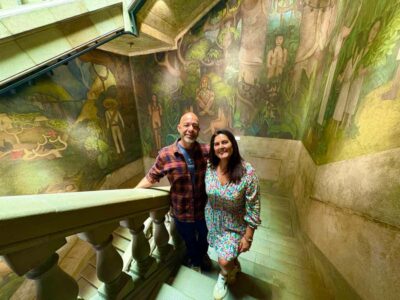
UNAM’s campus is not just a university stop. It is an open-air lesson in Mexican art, architecture, politics, and student life, with the Biblioteca Central and its huge Juan O’Gorman design as the visual centerpiece. The tour then moves to murals by Siqueiros, Chávez, Eppens, and others before finishing at the Olympic Stadium.
I like the clear two-hour route, which gives you a useful introduction without taking up a full day. I also like the focus on the 1968 Olympic Games, a subject that adds political and social weight to the art. The main consideration is that this is a walking tour with a fixed, fairly brisk schedule, so anyone wanting a slow art study may need more time afterward.
Key points
- Juan O’Gorman’s Biblioteca Central: See one of UNAM’s most striking buildings and learn how its exterior tells a story through images.
- Murals by several major artists: The route includes work by Siqueiros, Chávez, Eppens, and others, giving you more than a single artist’s view of Mexico.
- 1968 at the Olympic Stadium: Connect UNAM’s art and architecture with the history of the Mexico City Olympic Games.
- Diego Rivera connection: The stadium stop includes discussion of Rivera’s mural, adding another major name to the tour.
- Small group format: A maximum of 15 people should make it easier to hear the bilingual guide.
- Flexible booking: You receive confirmation at booking and can cancel free of charge up to 24 hours before the start time.
Why UNAM Works So Well as a Walking Tour
The National Autonomous University of Mexico, usually called UNAM, gives you several kinds of sightseeing in one place. You see monumental buildings, public murals, modern Mexican art, and a major sports venue without moving between distant parts of Mexico City.
That matters because the art here was designed for public life. These are not isolated paintings in quiet galleries. They belong to a university campus, where students, teachers, athletes, and visitors pass by them every day.
I find this setting more useful than a standard museum visit if you want to understand how Mexican artists used architecture to reach a broad audience. The guide’s job is not simply to identify a painter. It is to explain why the works were placed here and how the university connects to wider events in Mexico.
The tour lasts about two hours. That is enough time to get the main story and see the three planned areas, but it is not a full survey of UNAM. Think of it as a focused introduction that helps you decide what deserves a longer return visit.
The group can include up to 15 people. That is large enough to provide a social atmosphere, yet small enough that a bilingual guide should be able to address the group without the experience feeling like a moving crowd.
More Mural Tours in Mexico
- CDMX: Xochimilco, Coyoacan, Frida Kahlo Museum & Murals Tour
★ 4.4 · 3,025 reviews - Cancun Street Food Tour with Food Stalls, Local Market and Murals
★ 5.0 · 723 reviews - Mexico City; ART NACO : Murals & Street Art Bike Tour
★ 5.0 · 284 reviews
Biblioteca Central and Juan O’Gorman’s Visual Story
The first stop is the UNAM Biblioteca Central, an architectural work by Juan O’Gorman. You have about 20 minutes here, and admission is included at no extra cost.
The building is important because it combines architecture with an enormous visual program. Rather than treating the library as a plain structure, O’Gorman made it part of the campus story. The guide can help you read the building as more than a dramatic façade and point out how its design reflects ideas about Mexico, education, and society.
Twenty minutes is a sensible amount of time for an opening stop. You can take in the scale, hear the basic explanation, and get oriented before the tour moves toward the broader mural program.
The limitation is simple: if you enjoy architectural detail, you may want to stay longer than the scheduled stop allows. Use the first visit to note what catches your eye, then return later if the building becomes one of your main interests.
This is also a good place to appreciate the value of having a guide. Large public artworks can look impressive while remaining hard to interpret. A clear explanation gives you a way into the images and helps you notice details you might otherwise pass without understanding.
One Hour With UNAM’s Murals
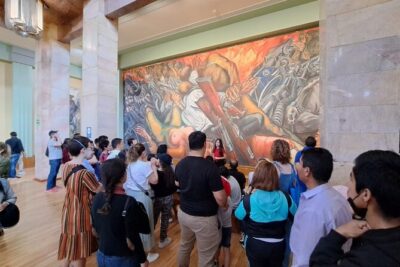
The largest part of the tour is devoted to the murals at UNAM, with roughly one hour set aside for work by Siqueiros, Chávez, Eppens, and other artists.
This part should appeal to you if you want variety. Instead of hearing only about one painter, you get a wider view of the mural tradition associated with the university. Different artists bring different styles and concerns, so the stop can show how public art changed from one work to another.
David Alfaro Siqueiros is one of the best-known names in Mexican muralism, and his inclusion gives the tour a direct link to one of the country’s major artistic movements. Chávez and Eppens broaden the picture. The supplied details do not identify every mural or explain the exact order of the stops, so your guide will determine which works receive the most attention on the day.
An hour is a useful middle ground. It is long enough for explanation and comparison, but short enough to keep the tour moving. If you are new to Mexican mural art, this section should give you a working vocabulary: look at the scale, the public setting, the figures, the symbols, and the way each artist addresses Mexican identity and history.
I would not expect a quiet, museum-style study session. You are outdoors or moving through a public university setting, and the tour has to keep to its schedule. If you want to photograph every detail or copy down every artist’s name, you may need independent time after the tour.
The biggest value here is context. You are not only looking at large paintings. You are seeing how art can function as part of a civic space. The campus itself becomes part of the lesson.
The Olympic Stadium and the Meaning of 1968
The final stop is Estadio Olímpico Universitario, with about 30 minutes devoted to the stadium, the 1968 Olympic Games, and Diego Rivera’s mural.
This is where the tour moves beyond art appreciation. The 1968 Games are tied to a complicated moment in Mexico’s modern history, and placing that subject beside UNAM’s art gives the tour a stronger sense of purpose. The guide can connect the university, public architecture, international sport, and the political meaning of the period.
Diego Rivera’s mural adds another major artistic connection. Rivera is one of the central figures in Mexican muralism, so discussing his work at the stadium rounds out the earlier stops. It also gives you a chance to compare Rivera’s approach with the work associated with Siqueiros, Chávez, Eppens, and O’Gorman.
The half-hour timing keeps this stop focused. You should have enough time to understand why the stadium matters and how the 1968 Games fit into the story, but not enough for a full stadium tour or an extended political history lesson.
This stop may be the most rewarding part for anyone interested in modern Mexico. It links art to real events rather than treating murals as decoration. If your interests are mainly architectural, you may prefer the library. If you want historical context, the stadium should carry more weight.
More Mural Tours in Mexico City
- Walking Tour – Impressive murals in Historical Center of Mexico City
★ 5.0 · 224 reviews - Mexico City: Art Naco, murals & street art bike tour
★ 4.7 · 166 reviews - Xochimilco floating gardens, Coyoacan and UNAM murals
★ 4.0 · 53 reviews - Mexico City: Diego Rivera’s Murals Guided Walking Tour
★ 5.0 · 49 reviews
Fernando’s Storytelling and the Guide’s Role
The tour includes a bilingual guide and is offered in English. One guide specifically associated with the experience is Fernando, whose approach is described as strong on the university’s construction, development, and the events connected with 1968.
That detail matters because UNAM requires more than a list of artist names. You want someone who can explain how the campus developed and why its buildings and murals belong together. Fernando’s focus on storytelling suggests a guide who connects separate stops instead of treating them as unrelated photo opportunities.
The guide is included in the price, but tips are not. Tipping is therefore an extra cost to consider if you feel the service deserves it.
A good guide also helps with pacing. The route includes three stops, each with a different purpose. The library introduces the architecture, the mural section widens the art story, and the stadium brings in sport and politics. Without that structure, the tour could feel like a collection of impressive walls. With it, the campus becomes easier to understand.
The available information does not promise a particular guide for every departure, so you should not assume Fernando will lead your date. Still, his role gives you a useful sense of the kind of interpretation this experience aims to provide.
Is $53.46 a Fair Price?
At $53.46 per person, this is not the cheapest way to walk around a university campus. The buildings and murals listed here have free admission, so you are paying mainly for the guide, the planning, and the connections between the sites.
That can be good value if you want historical explanation. UNAM is large, and a first-time visitor could easily see the famous buildings without understanding their place in Mexican art or the importance of 1968. A focused guide saves you from piecing the story together on your own.
The price is less compelling if you already know UNAM well, have studied Mexican muralism, or prefer to explore at your own pace. In that case, the two-hour format may feel restrictive, especially since the public sites themselves do not charge admission.
I would judge the value by your interests. For a first visit to UNAM, especially if you want an English-language introduction, the cost can make sense. You are buying interpretation rather than entry tickets.
The group limit of 15 also helps explain the price. This is not advertised as a huge coach excursion, and a smaller group should make it easier to hear the guide and ask a question during the walk.
Meeting Point, Timing, and Practical Details
The tour starts at Rectoría de la UNAM, Escolar, C.U., in Coyoacán, Mexico City. It ends back at the same meeting point, which makes planning easier because you do not need to arrange a separate pickup after the walk.
The site is near public transportation. The information provided does not specify a particular station, route, or travel time, so check your route to the meeting point before setting out.
The tour runs for about two hours. Since the schedule includes walking between the library, mural areas, and stadium, wear practical shoes and allow enough time to arrive at the starting point. That is basic advice rather than a special tour rule, but it matters when your experience depends on staying with the group.
Most travelers can participate. No special restriction is stated, though the tour is still a walking activity, and the fixed schedule may not suit someone who needs frequent pauses.
Mobile tickets make arrival simpler. Confirmation is sent when you book, and the experience is offered in English with a bilingual guide.
You can cancel for a full refund up to 24 hours before the start time. Cancellations or changes made less than 24 hours before the start are not accepted for a refund, and the cut-off uses local Mexico City time.
Who Will Get the Most From This Experience?
I would recommend this tour to a first-time UNAM visitor who wants the campus explained rather than simply photographed. It is also a good match for anyone interested in public art, Mexican muralism, university architecture, or the history surrounding the 1968 Olympic Games.
It suits you especially well if English-language guiding is important. The route is short enough to fit into a morning or afternoon, and the return to the original meeting point keeps the rest of your day open.
Families and mixed-interest groups may also find the format useful because the tour combines art, architecture, sport, and history. You do not need to be an art specialist to follow the main story.
I would be more cautious if you want a slow, highly detailed art seminar. The one-hour mural segment and 30-minute stadium visit give you a strong overview, not an exhaustive study of every work.
Should You Book the UNAM Murals Tour?
Book it if you want a guided introduction to UNAM that links O’Gorman’s library, several important muralists, the Olympic Stadium, Diego Rivera, and the events of 1968. The strongest reason to go is the storytelling, particularly the focus on how the university was built and how its art connects with Mexico’s modern history.
Skip it if you prefer total independence or already have a detailed plan for exploring the campus. The attractions themselves are free, and the fixed two-hour schedule will not satisfy every art lover.
For most first-time visitors, I think the guide is the real purchase. You get a compact route, a bilingual explanation, a small maximum group, and a clearer sense of why UNAM is one of Mexico City’s most important places for public art.
FAQ
How long does the UNAM murals tour last?
The tour lasts approximately two hours.
Where does the tour begin?
It begins at Rectoría de la UNAM, Escolar, C.U., Coyoacán, 04510 Ciudad de México, CDMX, Mexico.
Where does the tour end?
The activity ends back at the meeting point.
What language is the tour offered in?
The tour is offered in English and includes a bilingual guide.
What will I see on the tour?
You will visit Biblioteca Central, see murals by Siqueiros, Chávez, Eppens, and others, and visit Estadio Olímpico Universitario to discuss the 1968 Olympic Games and Diego Rivera’s mural.
How large is the group?
The tour has a maximum of 15 travelers.
Can I cancel for a full refund?
Yes. You can cancel at least 24 hours before the experience starts for a full refund. Cancellations or changes made less than 24 hours before the start are not accepted for a refund.
More Street Art Walking Tours in Mexico City
- Mexico City: History on Walls. Mexican Murals Walking Tour
★ 5.0 · 2 reviews - Mexico City: The Murals of Mexico Semiprivate Walking Tour
★ 5.0 · 2 reviews
More Street Art Walking Tours in Mexico
- History and Murals: Walking Tour Guadalajara
★ 5.0 · 237 reviews - Street Art Walk
★ 4.5 · 7 reviews - Mexico City: Historic Center Walking Tour with Murals
★ 5.0 · 6 reviews - Private Walking Tour Guadalajara History and Murals with Guide
★ 5.0 · 6 reviews
Just added around Mexico
- Xochimilco floating gardens, Coyoacan and UNAM murals★ 4.0 · 6 reviews
- UNAM: Murals & Revolution★ 4.9 · 8 reviews
- Street Art & Cemetery Cultural Tour – half day★ 5.0 · 3 reviews
- Graffitis & Munchies biketour Playa del Carmen★ 4.5 · 18 reviews
- Street Art Walk★ 4.5 · 7 reviews
- Diego Rivera’s murals, hidden treasures★ 5.0 · 21 reviews
- Private Street Food & Mural Art Tour in Mexico City★ 3.5 · 3 reviews
- Private Mexico City Mural Art Tour★ 5.0 · 13 reviews
Mexico City Street Art Tours, compared.
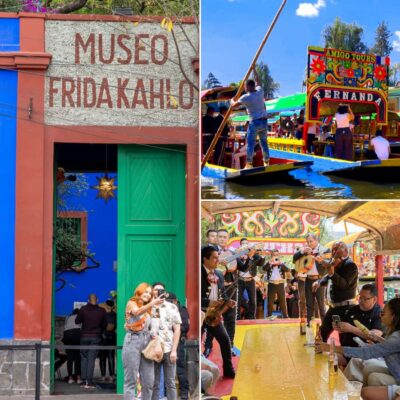
Xochimilco, Coyoacan, Frida Kahlo Museum & Murals Tour
Read our review →
Mexico City; ART NACO : Murals & Street Art Bike Tour
Read our review →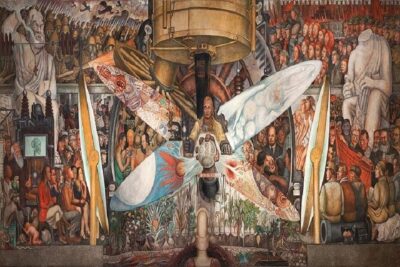
Walking Tour – Impressive murals in Historical Center of Mexico City
Read our review →
Iztapalapa: Cable Car Tour and Urban Art From the Heights
Read our review →
Xochimilco floating gardens, Coyoacan and UNAM murals
Read our review →