
REVIEW · MEXICO CITY
Mexico City: Murals at the Museum of San Ildefonso
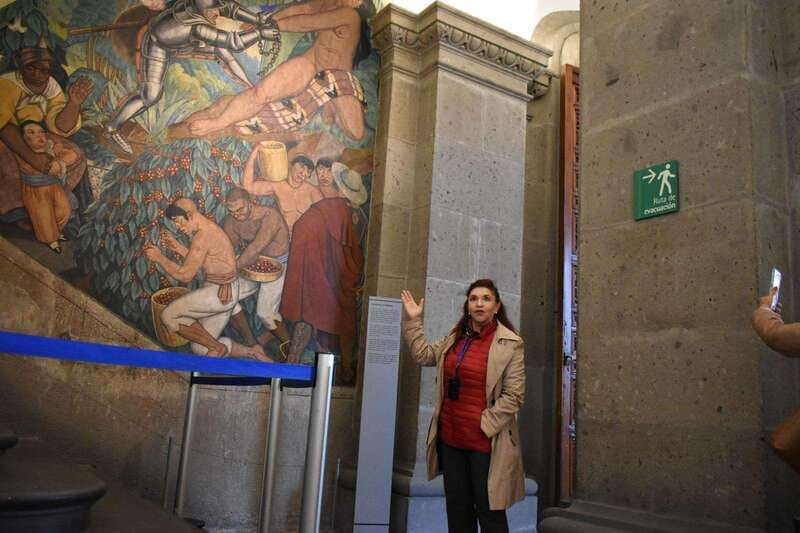
The most rewarding part of this San Ildefonso visit is hearing Prof. Cristina Ríos explain each mural in front of the actual fresco. She connects Orozco’s figures, pre-Hispanic references, and popular symbols to the social movements that shaped post-Revolutionary Mexico. I especially like the small group, limited to 10, and the use of headsets when more than six people attend.
I also like that this is not just an art tour. It uses the murals as a way to read Mexico’s political ideals and social hopes. The main consideration is the pace: two hours inside a historic building, with two stair levels and murals on the walls, may feel demanding for young children or anyone who prefers a quick museum visit.
Key points to know before you book
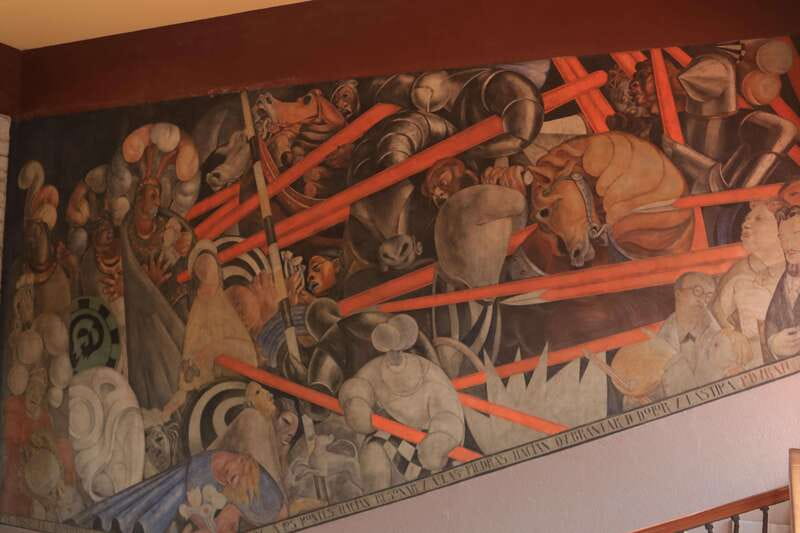
- Orozco is the main focus: The tour centers on José Clemente Orozco’s murals and his view of Mexican social movements.
- Cristina Ríos leads the visit: She offers detailed explanations in English or Spanish at each fresco.
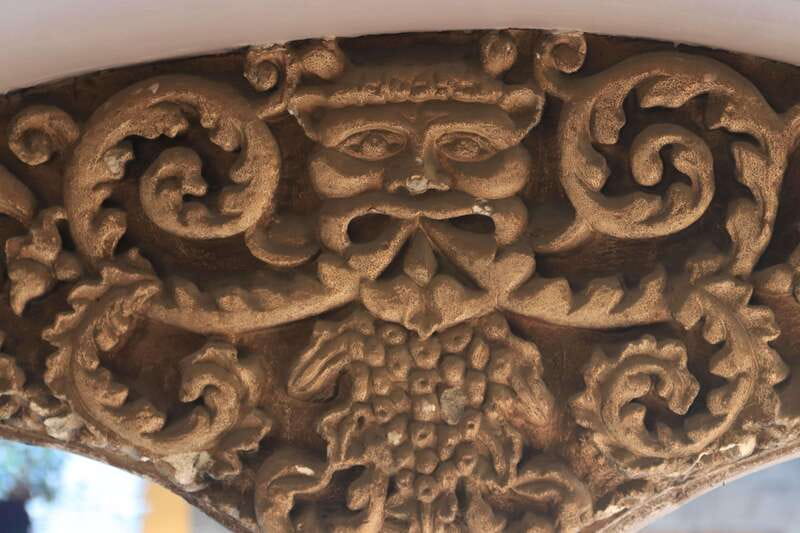
- San Ildefonso is part of the experience: You meet at the former college, whose exterior has a seventeenth-century Baroque facade.
- Other mural founders appear in the story: Jean Charlot, Fernando Leal, and Ramón Alva de la Canal help place Orozco within Mexico’s early mural movement.
- The group stays small: A maximum of 10 people makes it easier to hear, ask questions, and keep your attention on the walls.
- Plan for museum rules: Large bags, food, drinks, strollers, bikes, pets, and vaping are not allowed.
Why Orozco’s murals reward a guided visit
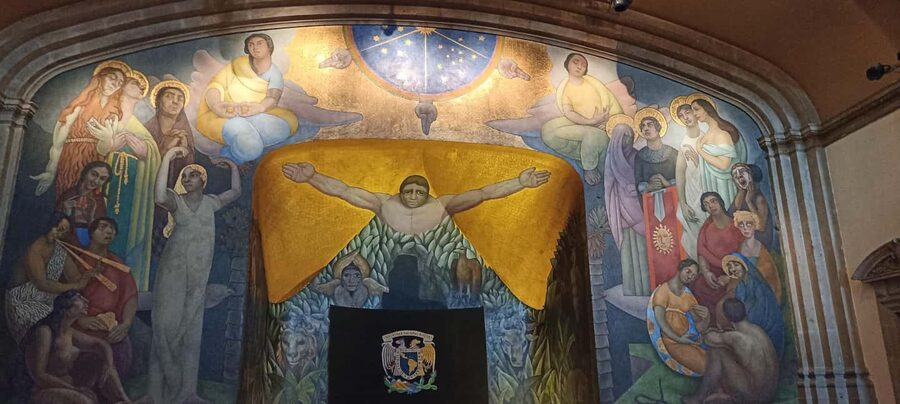
Mexico City has plenty of museums where you can walk past famous art, take a photo, and move on. San Ildefonso asks for a slower look. Its murals are not simply decorative scenes placed on old walls. They were part of a post-Revolutionary effort to use public art for education, political thought, and social change.
That idea is important to this tour. You are not only being shown what appears in the frescoes. You are being asked to think about why the artists used certain images and how those images helped tell a national story.
Orozco is the central figure. His work gives the visit a serious, sometimes difficult tone. The murals provide a way to consider social movements through the eyes of a painter who treated history, power, suffering, and hope with great force.
I like this approach because it keeps the art tied to real questions. What should public education do? How can art speak to people who may not have access to books or formal schooling? Can a mural help create a shared idea of Mexico?
The tour also introduces the spirit of other early muralists, including Jean Charlot, Fernando Leal, and Ramón Alva de la Canal. That wider view matters. It helps you see Orozco as part of a group of artists shaping a new visual language, rather than as an isolated genius.
More Mural Tours in Mexico
- CDMX: Xochimilco, Coyoacan, Frida Kahlo Museum & Murals Tour
★ 4.4 · 3,025 reviews - Cancun Street Food Tour with Food Stalls, Local Market and Murals
★ 5.0 · 723 reviews - Mexico City; ART NACO : Murals & Street Art Bike Tour
★ 5.0 · 284 reviews
Meeting Prof. Cristina Ríos at San Ildefonso
You meet Cristina Ríos at the entrance of the Museum of San Ildefonso, at the information desk. Look for her wine-colored identification card with her name around her neck.
The meeting point is on Justo Sierra Street. The location is easy to identify because the facade belongs to the former College of San Ildefonso and has a seventeenth-century Baroque style. Across the street are the Templo Mayor ruins and Porrúa’s Library, useful landmarks if you are finding your way through the historic center.
I recommend arriving with only what you need. The activity does not allow luggage or large bags, and the restrictions also include regular bags, baby carriages, food, drinks, bikes, and vaping. Assistance dogs are allowed, but other pets are not.
The setting gives the tour a good start. You are not meeting at a generic street corner before being rushed into a museum. You begin at a historic institution whose architecture already hints at the layers of Mexico City around you.
Inside the former college: a two-hour art walk
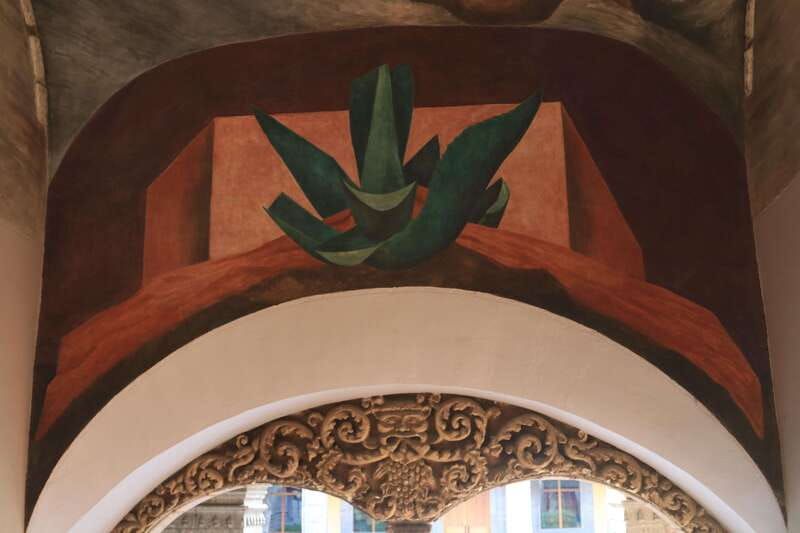
The museum portion lasts about two hours, within a total activity time of two and a half hours. The visit is a walking tour through the former college, with the murals displayed on its walls and across two stair levels.
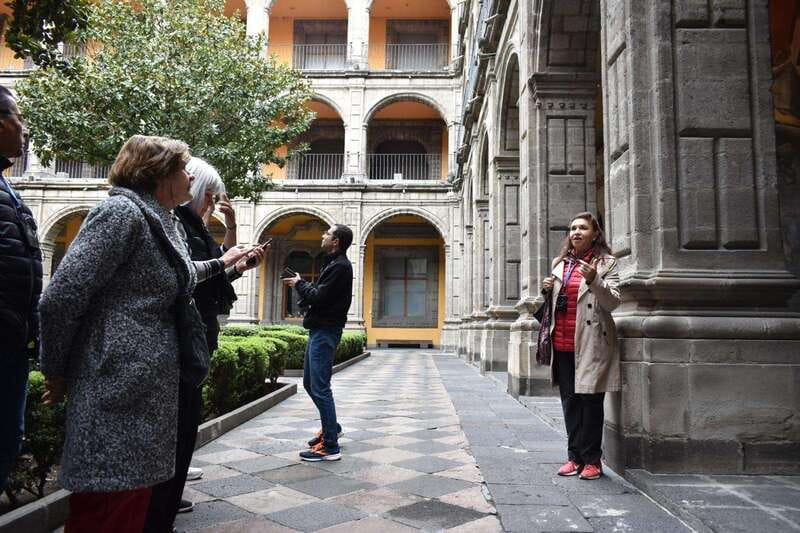
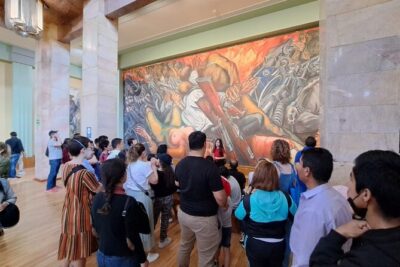
The route is not described as a series of separate stops with a long list of unrelated exhibits. Instead, Cristina guides you through the frescoes and explains them where you see them. That placement is useful. You can look at the scale, arrangement, and surrounding architecture while listening to the interpretation.
When a guide explains a painting away from the artwork, you have to hold the image in your head. Here, the explanation comes as you face the fresco. That allows you to check details for yourself and notice how one scene relates to another.
If the group has more than six people, headsets are provided so you can hear clearly. That is a practical touch in a large historic interior, where sound can carry unevenly. In a group of up to 10, you should still have a reasonable chance to stay close enough to follow the discussion.
The tour takes place rain or shine. Since most of the scheduled visit is inside, weather should not change the central experience, but you still need to handle the walk to the meeting point in poor conditions.
Reading Orozco through social movements
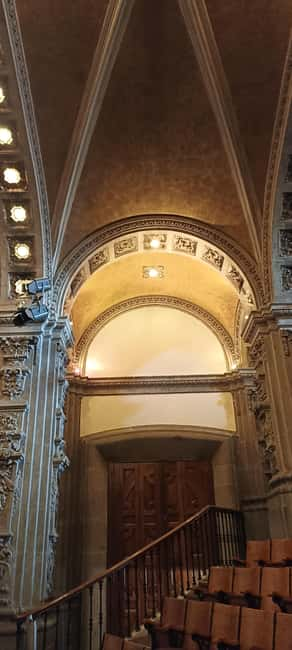
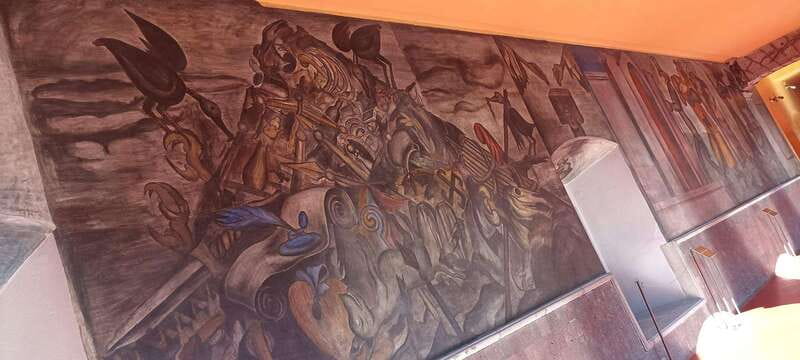
The strongest part of the program is its focus on the social meaning of the murals. Orozco’s work is presented as a visual record of post-Revolutionary Mexico, but not a neutral one. The paintings reflect a particular artistic and political viewpoint.
That distinction is worth keeping in mind. A mural can show a historical event while also arguing about that event. It can praise, criticize, warn, or ask the viewer to imagine a different society.
Cristina’s explanations focus on the lives and styles of the artists as well as the history around them. That combination gives you two useful ways into the work. You learn what the painters were trying to do, and you learn how their choices fit the larger social moment.
The tour also points out pre-Hispanic and popular references used as metaphors. These references were not treated as isolated decoration. They helped the muralists reach toward ideas of popular education and social transformation.
You may find this especially helpful if Mexican muralism seems confusing at first. The movement brings together art, history, politics, education, and national identity. Without a guide, it is easy to see dramatic figures and bold compositions without understanding the argument beneath them.
With Cristina, the paintings become part of a larger question about social utopia. The murals search for an ideal society, while also presenting a historical narrative and a political aesthetic. You do not need a background in art history to follow this, but you should come ready to think about more than color and technique.
More Mural Tours in Mexico City
- Walking Tour – Impressive murals in Historical Center of Mexico City
★ 5.0 · 224 reviews - Mexico City: Art Naco, murals & street art bike tour
★ 4.7 · 166 reviews - Xochimilco floating gardens, Coyoacan and UNAM murals
★ 4.0 · 53 reviews - Mexico City: Diego Rivera’s Murals Guided Walking Tour
★ 5.0 · 49 reviews
The role of Jean Charlot, Fernando Leal, and Ramón Alva de la Canal
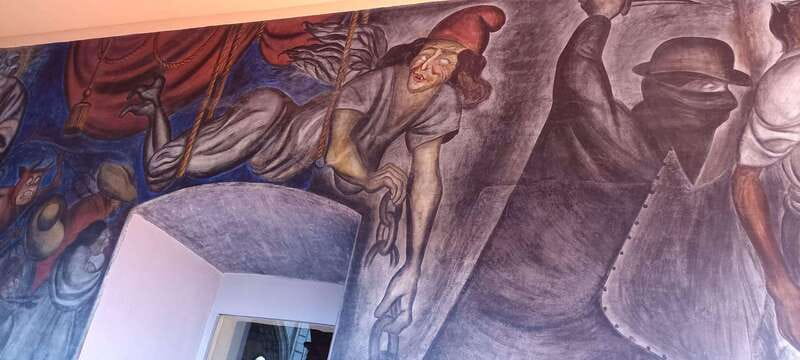
Orozco receives the most attention, but the tour also introduces Jean Charlot, Fernando Leal, and Ramón Alva de la Canal. This is useful because the founders of Mexican muralism did not all approach the project in exactly the same way.
The provided information does not assign a separate, lengthy section of the tour to each artist, so you should not expect four independent museum tours in one morning. Instead, these painters help create the wider frame around Orozco’s work and the post-Revolutionary mural project.
I appreciate that distinction. A short tour has to choose its center. Making Orozco the main subject gives the visit a clear path, while mentioning the other artists prevents the story from becoming too narrow.
The result should suit you if you want a focused introduction rather than an exhaustive survey of every muralist. You leave with a stronger sense of why San Ildefonso matters and how these artists used public frescoes to reach a broad audience.
What the architecture adds to the experience
The former College of San Ildefonso is not just a container for the murals. Its Baroque facade and interior structure shape how you encounter the art.
The two stair levels matter in practical terms. You will not spend the full visit standing in one open gallery. The route includes movement through the building, and the frescoes on the walls make the architecture part of the viewing experience.
For some people, this will make the tour feel more connected to the building’s past. For others, the stairs and extended walking may require a little more care. Wheelchair assistance is available through an elevator, so accessibility support is offered, but you should make use of that option if needed.
The tour is listed as wheelchair accessible. It is not suitable for children under 10 or people over 95, and the two-hour museum visit is the main reason to take those limits seriously. The experience asks for attention and a fair amount of time on your feet.
Is $37 a fair price?
At $37 per person, this is more than the cost of simply entering a museum if you prefer to look on your own. The value depends on how much you want interpretation.
You are paying for museum admission, a live guide, and a focused two-and-a-half-hour experience. Cristina’s detailed explanations are the main reason the price can make sense. She covers the artists’ lives, their distinct styles, Mexican history, and the meaning of individual frescoes.
I would consider it a fair price for someone who might otherwise leave San Ildefonso with only a general impression of Orozco’s dramatic murals. A guide can save you from guessing at the political and cultural references, especially if you are new to Mexican muralism.
The value is less clear if you already know Orozco’s work well or prefer to read wall text at your own speed. This is a structured tour, not a casual drop-in visit. You will follow the guide’s route and spend time listening at each mural.
The group limit helps. With no more than 10 participants, the price buys a more personal experience than a large coach-style tour. Headsets are supplied once the group exceeds six, which should help you keep up with the explanations.
Who will enjoy this San Ildefonso tour?
I would recommend it most strongly to adults interested in Mexican history, political art, architecture, or the development of public education. It also suits anyone who has seen mural images before but wants help understanding the ideas behind them.
You do not need formal art training. The tour is built around clear explanations, and the guide speaks English or Spanish. If you like connecting paintings to the societies that produced them, you should find plenty to consider.
It is a good match for a short Mexico City stay because the visit has a clear focus. You can spend one morning learning about Orozco and the early mural movement without committing to a full day of museums.
Families with children under 10 should choose another activity, since this tour is not suitable for them. Older visitors should also consider the two-hour museum visit and the two stair levels. Wheelchair assistance is available, but the building still requires advance attention to movement and access.
Practical details that affect your morning
The activity lasts 2.5 hours, with roughly two hours devoted to the museum visit. Starting times vary, so you need to check availability when booking.
English and Spanish tours are available. Admission, the live guide, and headsets for groups larger than six are included.
The experience is offered in a small group of up to 10 people. That size should make it easier to hear Cristina, ask a question, and remain near the artwork. It also means you are committing to a group schedule rather than exploring alone.
You can cancel up to 24 hours in advance for a full refund, and you can reserve now and pay later. Those terms are useful if your Mexico City plans are still shifting.
Most important, arrive ready to leave large items behind. Food and drinks, luggage, large bags, strollers, bikes, pets, vaping, and baby carriages are not allowed inside the activity. Assistance dogs are the exception to the pet restriction.
Should you book the Orozco mural tour?
Book this tour if you want meaning and context, not just access to a museum. Cristina Ríos makes the murals the center of a larger story about post-Revolutionary social movements, public education, national identity, and the hopes of Mexican muralism.
I would skip it if you want a fast, independent look or already have a strong background in Orozco and the other early muralists. The best reason to book is the guide’s detailed explanation at each fresco, supported by a small group and included admission.
For most visitors who want to understand why San Ildefonso matters, $37 is a sensible use of a morning. Bring your attention, pack light, and give the murals time to speak.
FAQ
Where does the San Ildefonso mural tour meet?
Meet Cristina Ríos at the entrance of the Museum of San Ildefonso, at the information desk. The entrance is on Justo Sierra Street, opposite the Templo Mayor ruins and Porrúa’s Library.
How long does the tour last?
The full activity lasts 2.5 hours. The museum visit and guided walk take about two hours.
What does the $37 price include?
The price includes museum admission, a live guide with explanations at each fresco, and headsets when the group has more than six people.
Is the tour available in English?
Yes. The live tour is offered in English and Spanish.
Is the museum visit wheelchair accessible?
Yes. Wheelchair assistance is available through an elevator. The museum also has two stair levels with frescoes on the walls.
Can I cancel the booking if my plans change?
Yes. You can cancel up to 24 hours in advance for a full refund. You can also reserve now and pay later.
More Street Art Museums and Galleries in Mexico
- Explore Modern Art & Murals in Mexico City’s Best Museums
★ 5.0 · 2 reviews - Moco Museum Amsterdam Entrance Tickets with Banksy & More
★ 4.4 · 10,088 reviews - Moco Museum Barcelona Banksy & More
★ 4.6 · 2,340 reviews - Amsterdam: Streetart Museum STRAAT Entrance Ticket
★ 4.8 · 2,137 reviews
Just added around Mexico
- Xochimilco floating gardens, Coyoacan and UNAM murals★ 4.0 · 6 reviews
- UNAM: Murals & Revolution★ 4.9 · 8 reviews
- Street Art & Cemetery Cultural Tour – half day★ 5.0 · 3 reviews
- Graffitis & Munchies biketour Playa del Carmen★ 4.5 · 18 reviews
- Street Art Walk★ 4.5 · 7 reviews
- Diego Rivera’s murals, hidden treasures★ 5.0 · 21 reviews
- Private Street Food & Mural Art Tour in Mexico City★ 3.5 · 3 reviews
- Private Mexico City Mural Art Tour★ 5.0 · 13 reviews
Mexico City Street Art Tours, compared.
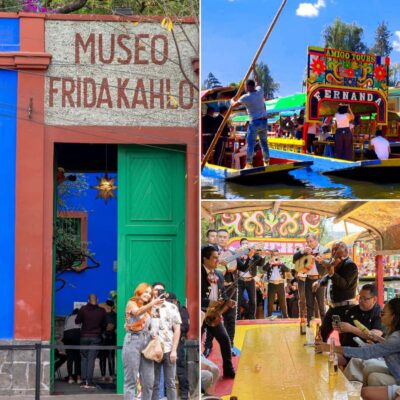
Xochimilco, Coyoacan, Frida Kahlo Museum & Murals Tour
Read our review →
Mexico City; ART NACO : Murals & Street Art Bike Tour
Read our review →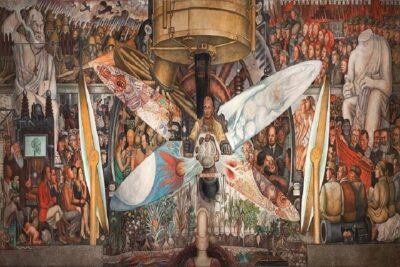
Walking Tour – Impressive murals in Historical Center of Mexico City
Read our review →
Iztapalapa: Cable Car Tour and Urban Art From the Heights
Read our review →
Xochimilco floating gardens, Coyoacan and UNAM murals
Read our review →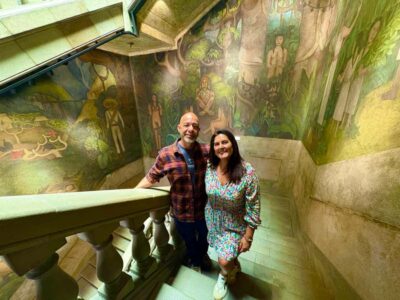
Browse the lists this tour appears in