
REVIEW · MEXICO CITY
Palace of Fine Arts Mural Tour
The best reason to book this tour is simple: it turns the Palacio de Bellas Artes from a grand building into a readable story. Inside, you’ll examine murals by Diego Rivera, José Clemente Orozco, David Alfaro Siqueiros, Jorge González Camarena, and Rufino Tamayo, with attention to the people, politics, and symbols packed into each scene.
I like the focused 60 to 90 minute format, which gives you a useful introduction without swallowing half a day. I also like the emphasis on the mural Rivera painted for Rockefeller Center and later destroyed because of its political message. The main consideration is that the tour covers many works in a short time, so you may want extra time afterward to look again on your own.
- Seventeen murals: See major works by Rivera, Siqueiros, Orozco, Camarena, Tamayo, and other Mexican artists.
- A political story: Learn how muralism carried ideas about revolution, power, workers, identity, and national history.
- León as a guide: León has led the tour in English with clear explanations of symbolism, artists, and historical setting.
- Architecture included: The tour covers the exterior and interior of the Palacio de Bellas Artes, not only the paintings.
- Central meeting point: Begin and end at the Palacio de Bellas Artes in Mexico City’s Centro Histórico.
- Small enough to follow: The group can include up to 35 people, so ask questions early if you want personal attention.
Why the Murals Matter More Than the Marble
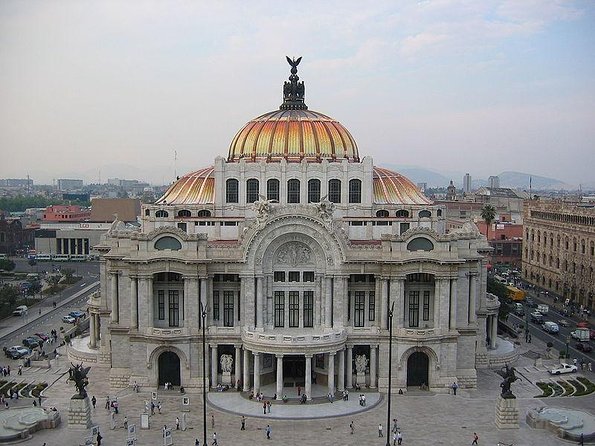
The Palacio de Bellas Artes is easy to admire as a building. Its scale, decorative details, and place in Mexico City’s historic center attract attention before you ever reach the paintings. But the murals are the real reason to slow down.
This is not a tour about pretty walls alone. Mexican muralism was made for public spaces, and the artists used large scenes to address ordinary people, political conflict, social change, and national identity. A guide helps you connect those broad ideas to the small details inside each painting.
The building was commissioned during the presidency of Porfirio Díaz, and the tour explains the history and context behind that major project. That background matters because the palace represents more than one moment in Mexico’s story. Its creation, decoration, and later artistic use bring together architecture, government, culture, and political debate.
The Palacio de Bellas Artes was declared a UNESCO World Heritage Site in 1987. That designation gives you a useful sense of its importance, but it does not replace looking closely. The pleasure of this visit comes from seeing how each artist handled Mexico’s past and present in a different way.
A Fast Orientation to the Palacio de Bellas Artes
The tour begins at Av. Juárez in front of the Palacio de Bellas Artes and returns to the same meeting point. That makes the outing easy to fit into a day in the Centro Histórico, especially if you are already visiting nearby sights.
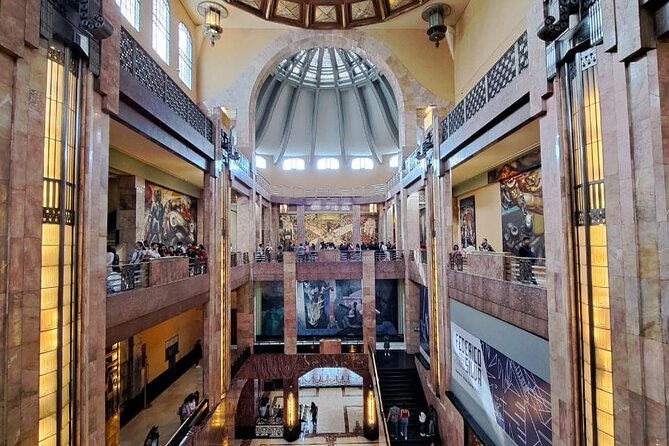
Your guide first explains the exterior and interior architecture. This is a smart part of the visit. Without it, you might rush toward the murals and miss how the building itself frames the art. The architectural introduction also gives you a clearer sense of why the palace became such an important cultural site.
The pace is likely to be active rather than leisurely. In roughly an hour to an hour and a half, the guide discusses 17 murals and several artists. You should expect interpretation and explanation, not long periods of quiet viewing.
That short length is useful if you are building a packed Mexico City schedule. It also means you should not expect a full study of every mural. The guide concentrates on major works and the ideas that link them.
More Mural Tours in Mexico
- CDMX: Xochimilco, Coyoacan, Frida Kahlo Museum & Murals Tour
★ 4.4 · 3,025 reviews - Cancun Street Food Tour with Food Stalls, Local Market and Murals
★ 5.0 · 723 reviews - Mexico City; ART NACO : Murals & Street Art Bike Tour
★ 5.0 · 284 reviews
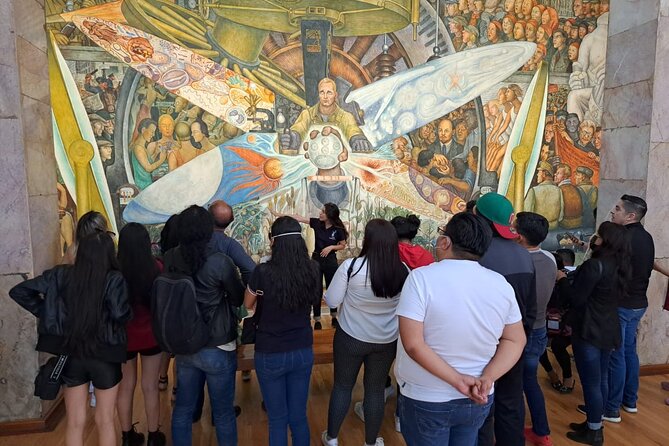
Diego Rivera’s Universe Controlled by Man
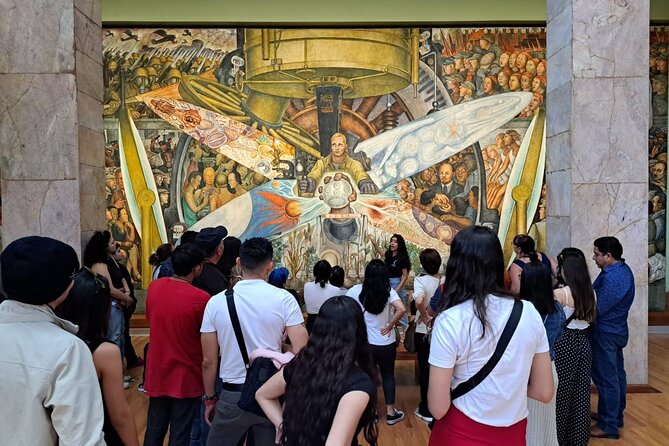
One of the central works is Diego Rivera’s Man, Controller of the Universe, a mural connected to the painting he created for Rockefeller Center in New York. That commission was destroyed because of Rivera’s political ideology, making the subject especially important in a tour about art and power.
The work gives the guide a chance to explain more than Rivera’s technique. You will hear about the political beliefs that shaped his murals and why a painting could become controversial enough to be removed. That story is one of the tour’s most useful connections between Mexico and the wider world.
Look closely at how the mural places people, industry, science, and political ideas into one large composition. You may find that the guide’s explanation helps you sort the many figures and symbols into a clearer argument.
This is also a good example of why seeing the mural in person matters. A reproduction can show you the subject, but a guide helps explain why its location, scale, and public setting matter.
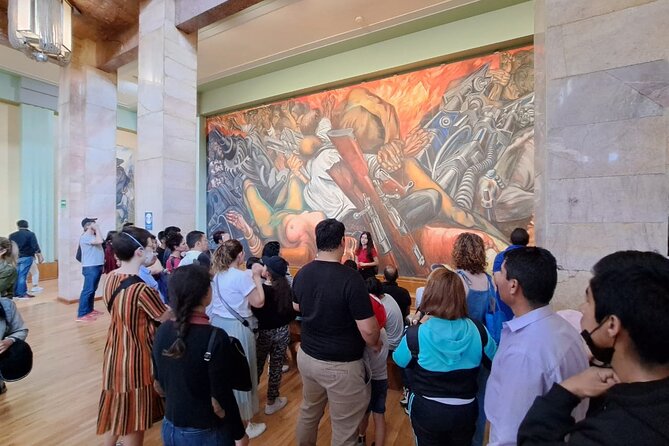
Orozco’s Katharsis and the Cost of Modern Life
José Clemente Orozco’s Katharsis brings a darker mood. The title suggests release through suffering or conflict, and the mural gives the tour a chance to compare Orozco’s approach with Rivera’s.
The guide discusses the symbolism and historical setting rather than simply pointing out the artist’s name. That is important here because Orozco’s work can feel forceful and difficult to read at first glance. You may find the explanation especially useful if you want help understanding the tension in the scene.
This stop also keeps the tour from becoming a parade of famous names. Rivera, Orozco, and Siqueiros did not express the same ideas in the same way. The contrasts among them are part of the point.
Rivera’s Carnival of Huejotzingo
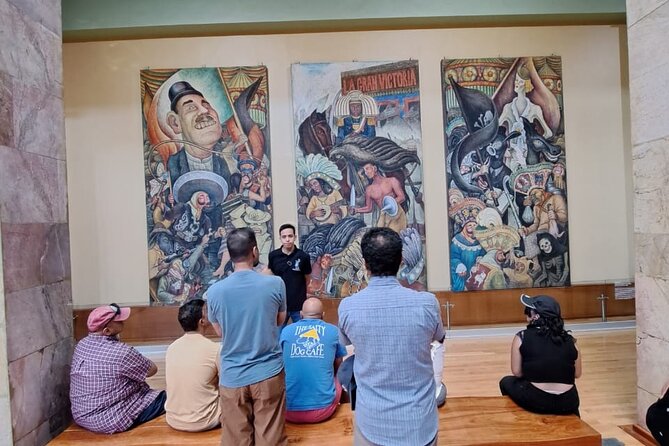
Rivera’s The Carnival of Huejotzingo offers another side of his work. The mural refers to a Mexican carnival and gives the guide room to discuss local tradition, social types, and the way Rivera folded cultural subjects into monumental painting.
You will want to pay attention to the difference between a scene based on a festival and the political murals elsewhere in the palace. The work shows how muralism could deal with popular culture as well as revolution and industry.
A good explanation here helps you read the event as more than decoration. Costumes, movement, and figures can carry social meaning. Since the tour covers many works quickly, this is a place where you may want to remember the title and take another look after the guided portion ends.
More Mural Tours in Mexico City
- Walking Tour – Impressive murals in Historical Center of Mexico City
★ 5.0 · 224 reviews - Mexico City: Art Naco, murals & street art bike tour
★ 4.7 · 166 reviews - Xochimilco floating gardens, Coyoacan and UNAM murals
★ 4.0 · 53 reviews - Mexico City: Diego Rivera’s Murals Guided Walking Tour
★ 5.0 · 49 reviews
Siqueiros: Torment, Apotheosis, and New Democracy
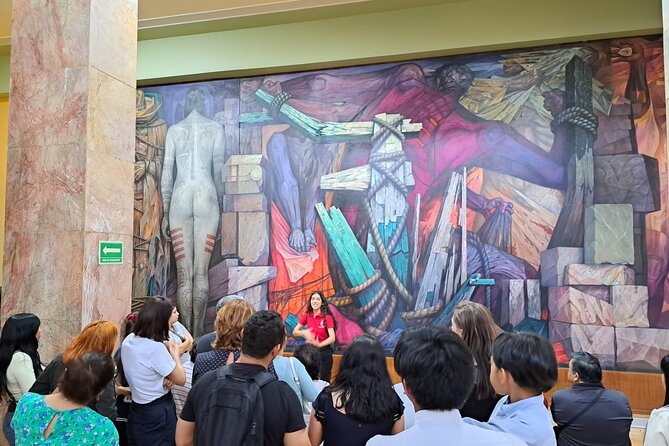
David Alfaro Siqueiros is represented by the diptych Torment and Apotheosis of Cuauhtémoc and the Triptych of the New Democracy. These works bring historical memory and political ideals into direct conversation.
The reference to Cuauhtémoc gives the guide an opening to explain how Mexican artists used figures from the past to address the present. The subject is not treated as a detached history lesson. It becomes part of a larger question about resistance, identity, and the meaning of national heroes.
The Triptych of the New Democracy shifts the focus toward political change. Here, the guide can show you how muralists used public art to express ideas that were meant to reach a broad audience.
These works may be among the more demanding stops on the tour. A short explanation of the subject, symbolism, and artist’s intent can make a major difference. If you prefer art that tells an obvious story, listen closely to the guide’s description before deciding what you think the mural means.
Camarena, Tamayo, and Rodríguez Lozano
Jorge González Camarena’s Liberation adds another voice to the group. Its title signals a subject tied to freedom and change, and the tour places it within the wider development of Mexican muralism.
The visit also includes Rufino Tamayo and the Piedad by Rodríguez Lozano. These names broaden the experience beyond the best-known muralists. You get a more useful picture of Mexican art when you see several approaches rather than treating Rivera, Orozco, and Siqueiros as the entire story.
Rufino Tamayo is particularly helpful in that comparison. His presence allows the guide to show that Mexican art did not follow one single path. Different artists handled national themes, symbolism, and visual style in their own ways.
The tour does not appear to promise a full museum course on every artist. Instead, it gives you a structured introduction to the major murals you can see inside the palace. For many people, that is the right amount for a first visit.
León’s Explanations and the Value of a Guide
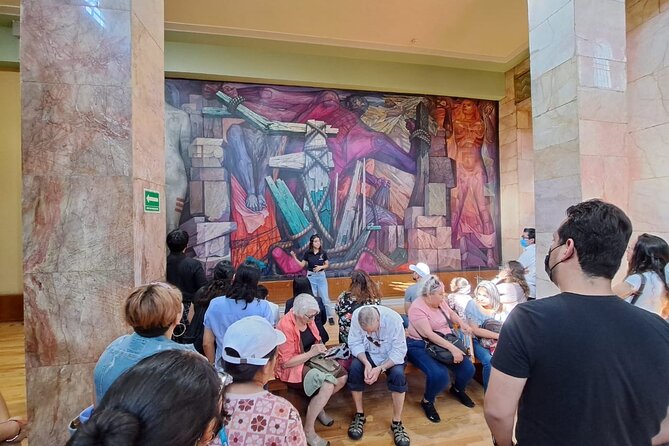
León is specifically identified as an English-speaking guide for this experience. He explains the murals, their symbolism, and the historical and cultural setting around them. His English has been described as strong, and he is noted for being patient and friendly while discussing each work.
That matters because the murals can be visually crowded. Without context, you may notice color and scale but miss the argument. A good guide gives you a framework: who created the work, what subject it addresses, and why the image belongs in this particular building.
The strongest part of the guiding style is the attention to stories. Rivera’s destroyed Rockefeller Center mural, the depiction of Cuauhtémoc, and the idea of a new democracy give you memorable threads to carry from one room to the next.
If León is not your guide on the day you book, the experience may vary. The provider is Educando con Cultura, and the tour includes a certified guide. Still, the available information points to a well-prepared English service, including one instance in which León handled the tour very well even though it was his first time leading it.
Is $56.75 a Fair Price?
At $56.75 per person, this is not the cheapest way to enter the Palacio de Bellas Artes. The value depends on how much interpretation you want and how comfortable you are reading art without help.
The price makes more sense if you want a short, organized introduction to 17 murals and the building’s architectural background. You are paying for a certified guide and a clear route through artists and subjects that can otherwise blur together.
The tour is less compelling if you only want to walk through the palace quickly, take photographs, and move on. In that case, a guided visit may feel expensive for a 60 to 90 minute activity.
There is one important detail to confirm before booking: the supplied information says both that entries are included and that the admission ticket is not included. Those statements conflict. Check the current booking terms so you know if the $56.75 covers entrance to the palace or only the guided service.
Timing, Group Size, and Practical Fit
The tour lasts about one hour to one hour and 30 minutes. That range gives the guide some flexibility, but you should plan around the longer time so you are not rushing to your next appointment.
The maximum group size is 35 people. That is not a private tour, and it may feel less personal than a small group. If you want to ask detailed questions, do not wait until the final mural. Speak up as the tour moves along.
The meeting point is the Palacio de Bellas Artes, Av. Juárez S/N, Centro Histórico de la Ciudad de México. The activity ends where it begins. It is near public transportation, and most people can participate. Service animals are allowed.
A mobile ticket is provided, and confirmation arrives when you book. The tour is offered in English, which makes it a practical choice if you want help with the art but do not speak Spanish comfortably.
You can cancel for a full refund up to 24 hours before the start time. Cancellations or changes made within 24 hours are not refunded or accepted, and the cut-off uses Mexico City local time.
Who Will Get the Most From This Tour?
I would choose this for a first visit to the Palacio de Bellas Artes, especially if you want the political and cultural meaning behind the murals rather than a quick look at famous paintings.
It suits you if:
- You want an English explanation of Mexican muralism.
- You enjoy learning how art connects to politics and national identity.
- You have only 60 to 90 minutes available.
- You prefer a guide to organize a large collection of paintings.
- You want to compare Rivera, Orozco, Siqueiros, Camarena, Tamayo, and Rodríguez Lozano.
It may not suit you if you want a quiet, self-directed museum visit or a long technical discussion of one artist. The group can reach 35 people, and the schedule requires the guide to keep moving.
The tour also works well for people who know Rivera’s name but little about the other muralists. By the end, you should have a clearer sense of how these artists differed and why their work belongs in the same building.
Should You Book the Palace of Fine Arts Mural Tour?
Book it if you want the Palacio de Bellas Artes to make sense, not merely look impressive. The guide-led format adds real value to murals filled with symbols, historical references, and political arguments.
At $56.75, it is best viewed as a focused introduction rather than a bargain museum walk. Confirm the admission question before paying, and allow extra time if you want to return to your favorite murals after the tour.
For a first visit, the combination of Rivera’s Rockefeller Center story, Siqueiros’s historical and political works, Orozco’s Katharsis, and the wider group of 17 murals makes this a strong choice. If you already know the palace well, you may prefer to explore independently.
FAQ
Where does the Palace of Fine Arts Mural Tour begin?
It begins at the Palacio de Bellas Artes, Av. Juárez S/N, Centro Histórico de la Ciudad de México, Cuauhtémoc, 06050 Ciudad de México.
Where does the tour end?
The activity ends back at the meeting point at the Palacio de Bellas Artes.
How long does the tour last?
The tour takes approximately one hour to one hour and 30 minutes.
Is the tour offered in English?
Yes. The tour is offered in English, and León is identified as an English-speaking guide for this experience.
How many people can join the tour?
The maximum group size is 35 people.
Is admission to the palace included?
The supplied details conflict on this point. One section says entries are included, while another says the admission ticket is not included. Check the current terms before booking.
Can I cancel for a full refund?
Yes. You can cancel at least 24 hours before the experience start time for a full refund. Cancellations or changes made less than 24 hours before the start time are not refunded.
Just added around Mexico
- Xochimilco floating gardens, Coyoacan and UNAM murals★ 4.0 · 6 reviews
- UNAM: Murals & Revolution★ 4.9 · 8 reviews
- Street Art & Cemetery Cultural Tour – half day★ 5.0 · 3 reviews
- Graffitis & Munchies biketour Playa del Carmen★ 4.5 · 18 reviews
- Street Art Walk★ 4.5 · 7 reviews
- Diego Rivera’s murals, hidden treasures★ 5.0 · 21 reviews
- Private Street Food & Mural Art Tour in Mexico City★ 3.5 · 3 reviews
- Private Mexico City Mural Art Tour★ 5.0 · 13 reviews
Mexico City Street Art Tours, compared.
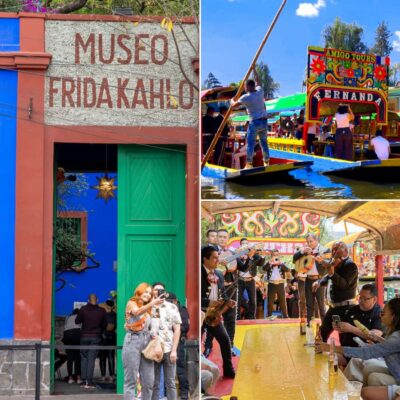
Xochimilco, Coyoacan, Frida Kahlo Museum & Murals Tour
Read our review →
Mexico City; ART NACO : Murals & Street Art Bike Tour
Read our review →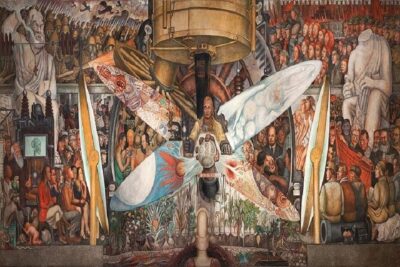
Walking Tour – Impressive murals in Historical Center of Mexico City
Read our review →
Iztapalapa: Cable Car Tour and Urban Art From the Heights
Read our review →
Xochimilco floating gardens, Coyoacan and UNAM murals
Read our review →
Browse the lists this tour appears in