
REVIEW · ITALY
Palermo: Street Art and Urban Life Walk
Palermo’s street art is not tucked away in a gallery. It appears on shutters, market walls, apartment blocks, and the everyday streets where people live. I like this tour for two clear reasons: Elena connects the art to Palermo’s social and political life, and the tram ride to Sperone takes you far beyond the usual center. The included artisanal gelato is a fine bonus, too.
The main consideration is the pace and setting. This is a three-hour walk with several tram rides, outdoor stops, and time in working-class neighborhoods. If you want Palermo’s grand churches and famous monuments, choose a traditional city tour instead. If you want the city as it feels today, this is a strong pick.
Key points to know before you book
- Street art with local context: Look beyond the paint and learn how murals relate to identity, hope, politics, the mafia, and social change.
- A real trip beyond the center: The tram carries you from Vucciria and Kalsa to Sperone, an area many first-time visitors never reach.
- Small group of up to 10: The size suits questions, discussion, and the occasional chat with people you meet along the way.
- Led by Elena: Her focus is not only on artists, but also on Palermo’s recent changes and daily life.
- Three hours for $45: Tram tickets, the guide, and a gelato tasting are included, making the price fair for a half-day city experience.
- Practical but active: Bring comfortable shoes, a hat, sunscreen, and a camera. Drinks are not included.
Why this Palermo walk feels different
Most city tours point you toward Palermo’s old churches, markets, and palaces. Those places matter, but this experience asks a different question: what does Palermo look like when you follow its creative life instead of its famous monuments?
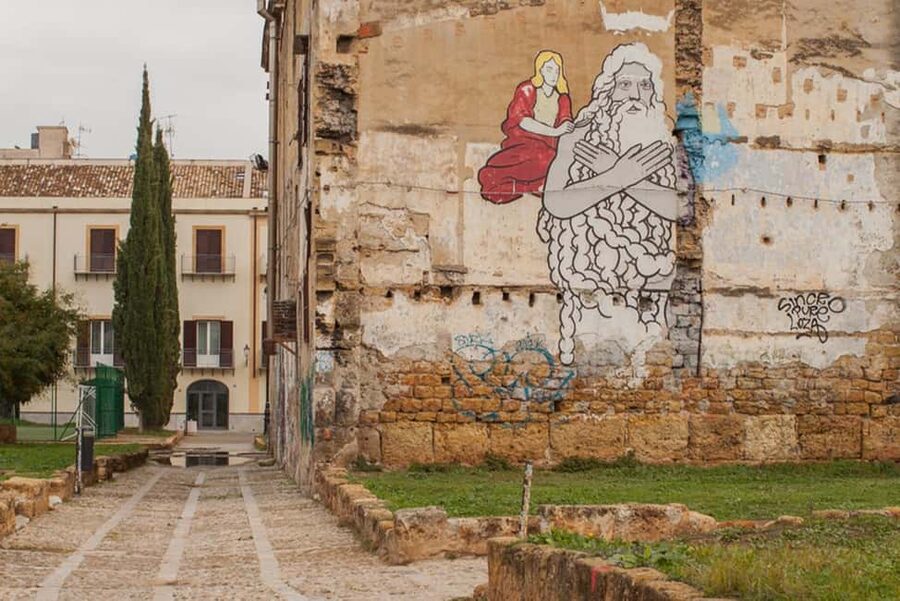
You begin at Epic Home, the tour operator’s base on Via Argenteria in Vucciria. From there, the route moves through streets where art sits beside ordinary routines. A painted shutter may be closed over a shop. A mural may share a wall with faded plaster, laundry, traffic signs, or balconies. That setting is the point. You are not looking at street art in isolation. You are seeing how it functions within the neighborhood.
I especially like the tour’s attention to daily life and change. The art becomes a way into larger subjects, including Palermo’s politics, the mafia, poverty, rebuilding, and the pride people feel in their districts. Elena’s approach, according to the experience details, is personal rather than academic. She lives in Palermo and presents the city through her own local view.
That can make the walk more open-ended than a standard sightseeing route. You may spend more time discussing what a work means and less time collecting a checklist of landmarks. For me, that trade is worthwhile, but it is important to know what you are booking.
A few more street art tours around Italy worth a look
- Naples Spanish Quarters Walking Tour Street Art, Folklore & Sweet
★ 5.0 · 797 reviews - Naples: Spanish Quarters Folk Street Art w/ Sweets Tasting
★ 4.9 · 788 reviews - Graffiti art tour in Rome
★ 5.0 · 714 reviews
Vucciria and Kalsa: art beside the old city
The opening walk takes you through Vucciria and the Kalsa area for about 30 minutes. Vucciria gives the tour an energetic start, with its market identity, narrow streets, and mix of old buildings and contemporary marks. Kalsa brings a quieter rhythm, though the exact feel depends on the time and route.
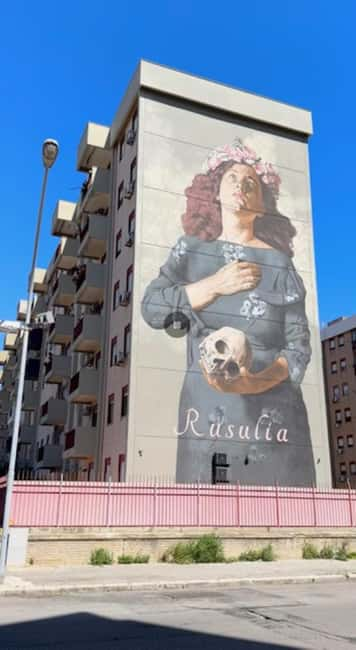
Here, you will see murals, painted shutters, and smaller pieces woven into the streets. Artists connected with this part of the route include TVBoy and SID. The works are not simply decorations placed for visitors. Their location matters. A shutter changes when it is open or closed. A mural looks different beside a market stall than it would in a gallery. The guide helps you notice those details.
TVBoy is known for work that often plays with public figures, popular culture, and political ideas. SID’s work adds another local name to the route. The point is not to memorize a list of artists. It is to see how different styles share the same streets and how public art can speak to people who pass by every day.
The Kalsa section also helps you slow down. Palermo is easy to experience as a parade of churches and photo stops. This walk gives you time to look at the surfaces between those sights: doors, walls, shutters, side streets, and the signs of repair or neglect. Those details can tell you plenty about a city still working through change.
The tram ride to Sperone
The first tram leg lasts about 15 minutes. It is a simple part of the plan, but it changes the experience. Instead of keeping you inside the compact old center, the tram carries you toward Palermo’s creative outskirts.
Public transport also gives you a better sense of distance. You see the city shift as you ride, and you are not sealed inside a private vehicle or limited to the streets already arranged for sightseeing. The tram is included in the $45 price, so you do not need to sort out a separate ticket for this part.
The route includes another walk of roughly 30 minutes after the first tram ride. The order of stops may change because of weather, local events, or logistics. That flexibility makes sense for an outdoor art tour, where a festival, blocked street, or changed piece can affect the day.
Sperone is one of the tour’s most useful features. The area has a strong working-class identity and is not usually part of a first visit to Palermo. You should not expect a polished art district built for tourists. Instead, the works appear within a neighborhood shaped by ordinary life and ongoing social concerns.
Large murals in Sperone
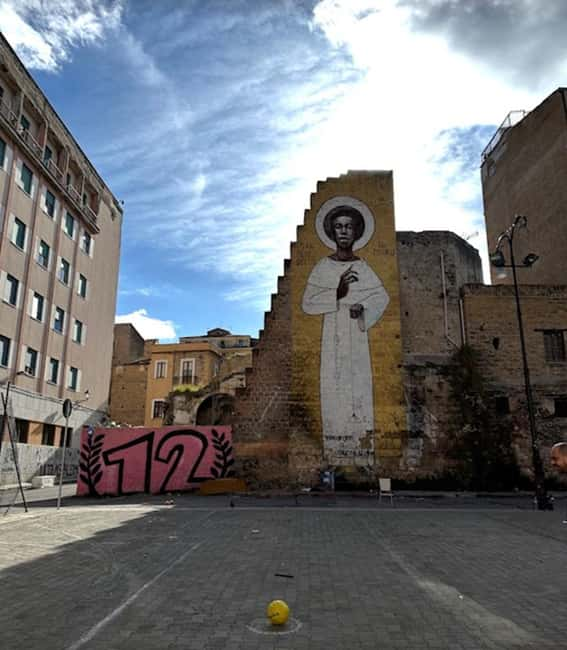
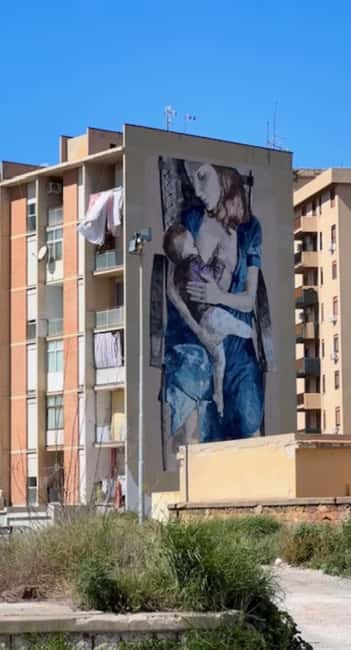
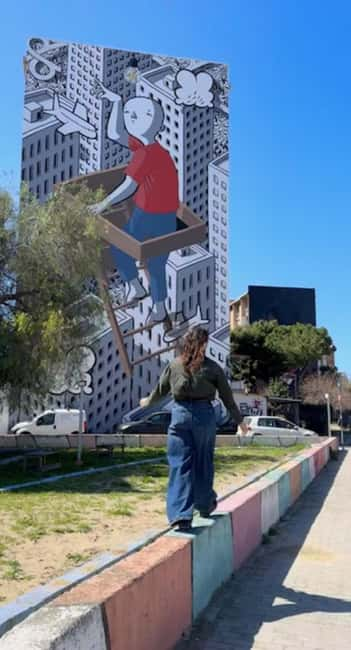
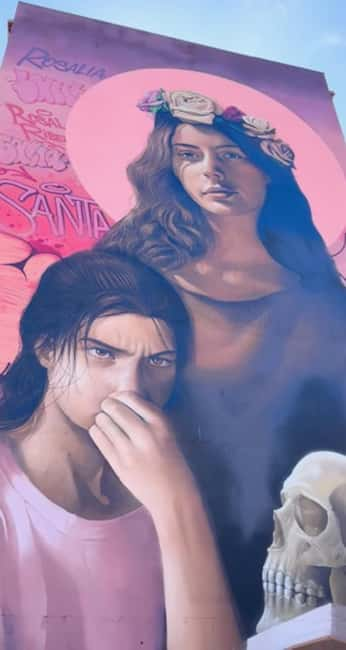
In Sperone, the scale changes. You see large works by artists including Igor Scalisi Palminteri, Rosk & Loste, Medianeras, and Millo. These murals give the neighborhood a very different visual character from the smaller works and shutters in the center.
Igor Scalisi Palminteri’s paintings often carry a direct human and social message. Millo is known for large black-and-white scenes with graphic lines and small figures set within broad urban spaces. Rosk & Loste and Medianeras add further styles to the route, giving you a useful sense of how varied Palermo’s public art can be.
The important thing is not only size. A huge mural can change how a building is read. It can draw attention to a street that might otherwise be ignored. It can also raise questions about who the neighborhood is for, who funded the work, and how art fits into a district facing real challenges.
You will spend around 25 minutes on the later walk before returning by tram and continuing on foot toward Via Argenteria. The route is not a quick photo stop at one famous wall. It is a movement through the area, with time to consider the murals in their setting.
This is where Elena’s wider knowledge is most useful. The experience includes discussion of Palermo’s history, politics, the mafia, and the city’s rebuilding. That does not mean the walk becomes a formal lecture. It means the art has a frame. You can connect a painted wall to the struggles and hopes of the people living around it.
Same walls, a different guide:
- Naples: Street Art, Wine and Food Tasting Walking Tour
★ 5.0 · 163 reviews - Naples Essentials: Monuments, Local Life & Street Art
★ 4.9 · 79 reviews - 4×4 tour of Orgosolo: Murals and typical lunch at the shepherd’s
★ 5.0 · 76 reviews - Rione Sanità tour among baroque, revival, street art & food
★ 4.8 · 59 reviews
Elena’s guiding style
Elena is the guide named for this experience, and the strongest praise centers on her personal connection to Palermo. She speaks English, Italian, and Spanish, so the tour can work well for an international group.
Her role is more than identifying artists. She explains the city’s background and uses her own experience to make the discussion feel grounded. The tour can also lead to small exchanges with local residents or people passing by. That kind of contact cannot be promised at every stop, but the small group makes it more likely that the walk feels like a conversation rather than a speech.
A group limited to 10 people is a real advantage here. Street art requires stopping, turning around, and sometimes looking from across the road. A large crowd would make that awkward. With fewer people, you can ask why a mural is located there, how the neighborhood has changed, or what a symbol means.
The tone also appears to be candid. Palermo is presented with its positive and difficult sides, not as a postcard version of Sicily. That balance matters. You may hear about beauty, creativity, community, poverty, crime, and the city’s effort to rebuild. If you prefer a light art walk with no serious discussion, this may feel heavier than expected.
What the three-hour route demands
The walking portions add up to at least 85 minutes on the stated schedule, with tram rides totaling about 30 minutes. In practice, the full three hours also includes stops to view and discuss the art.
Wear comfortable shoes. The route moves through city streets rather than a quiet museum, and the surface underfoot can vary. A hat and sunscreen are sensible in strong Palermo sun. Bring a camera, but do not let photographing every wall replace looking at the works in context.
The experience is listed as wheelchair accessible, which is useful information for planning. Still, outdoor routes can be affected by street conditions, crowds, weather, or a changed order of stops. If access needs are important to you, confirm the day’s route when booking.
There is an artisanal gelato tasting during the experience. It gives the group a pleasant pause and adds a small taste of local life without turning the tour into a food walk. Drinks are not included, so carry water or plan to buy one along the way.
Is $45 a fair price?
At $45 per person, this is not the cheapest way to spend three hours in Palermo, but the value is reasonable. You are paying for a specialist local guide, a small group, tram tickets, and gelato. The tram fare alone is not the main value. The real benefit is access to a route that would be hard to plan from a standard map.
You could find some of the murals independently, but you would need to identify the locations, work out the tram connections, and understand what you are seeing once you arrive. The guide adds interpretation, which is especially important when the art relates to politics, the mafia, local poverty, or social change.
The price is strongest for someone who has already seen Palermo’s main sights and wants another layer. It also works well early in a stay, since the route can show you parts of the city beyond the usual center. If your budget is tight, you may prefer a free self-guided walk, but you will give up Elena’s background and the convenience of the organized transport.
Free cancellation up to 24 hours before the start and the option to reserve now and pay later make the booking less rigid. Starting times vary, so check availability before planning the rest of your day.
Who should book this experience?
I would choose this tour if you want to understand Palermo as a living city rather than a collection of old sights. It suits art lovers, repeat visitors, photographers, students of urban culture, and anyone curious about how public art can reflect local concerns.
It is also a good choice for people who enjoy honest conversation. The strongest parts are not only the murals. They are the links between art and the city’s recent struggles, changing neighborhoods, and local identity.
Families with older children may enjoy it, especially if they are comfortable walking and discussing serious subjects. The tour is not designed as a children’s art activity, and the mafia and political context may not suit very young children.
You should skip it if you want guaranteed access to major monuments, a tightly scripted historical timeline, or a food-focused outing. You should also think twice if three hours outdoors, with walking and public transport, sounds tiring. This is an active city walk, not a seated presentation.
The best way to prepare
Meet at Epic Home, the tour base at Via Argenteria, 20, in Vucciria. Arrive ready to walk, since the route starts in the center before moving toward the outskirts.
Bring:
- Comfortable shoes
- A hat
- Sunscreen
- A camera
- Water or money for drinks
Keep your schedule slightly flexible. The order can change because of weather, events, or transport logistics. That is normal for street art, since public walls and city streets are not controlled like museum galleries.
I would also suggest leaving room after the tour. One participant described continuing on for an aperitivo with Elena and the group, but that is not part of the scheduled experience. Still, the tour’s conversational tone may give you useful ideas for the rest of your time in Palermo.
Should you book the Palermo street art walk?
Book it if you want a personal view of modern Palermo, not just another pass by its famous churches. The combination of Vucciria, Kalsa, tram travel, and Sperone gives the tour a strong sense of place. Elena’s focus on art, politics, the mafia, and social change adds substance to what could otherwise be a simple mural hunt.
The main caution is that the tour asks you to accept Palermo as it is: uneven, serious, creative, and sometimes uncomfortable. For me, that is the appeal. At $45, with a maximum of 10 people, tram tickets, and gelato included, it is a fair choice for anyone who wants to see how art lives on the city’s walls and in the lives around them.
FAQ
Where does the Palermo street art walk start?
The meeting point is Epic Home, the tour operator’s base at Via Argenteria, 20, in Vucciria.
How long does the experience last?
The tour lasts three hours. The route includes walks through Vucciria, Kalsa, and Sperone, plus two tram rides.
Which languages are available?
The live tour guide can lead the experience in English, Italian, or Spanish.
How large is the group?
The experience is limited to 10 participants.
Are tram tickets and gelato included?
Yes. Tram tickets and an artisanal gelato tasting are included. Drinks are not included.
Is the tour wheelchair accessible?
Yes, the experience is listed as wheelchair accessible. The order of stops can change because of weather, events, and logistics.
Just added around Italy
- Torpignattara Photo Tour: melting pot, street art and politics★ 5.0 · 5 reviews
- Rome: Pigneto Urban Art Walking Tour with Italian Aperitif★ 5.0 · 2 reviews
- Art & Craft: Beer Tour with Street Art in Rome★ 4.5 · 6 reviews
- Street Art of Spanish Quarters and Maradona Tour★ 3.5 · 3 reviews
- The Spanish Quarters, Street Art and Local Market Tour in Naples★ 5.0 · 23 reviews
- Private Street Art Tour: Exploring Milan’s Hype Neighborhoods★ 5.0 · 2 reviews
- Street Art&Urban Vibes in Milan’s Most Exciting Rising Areas★ 4.4 · 5 reviews
- Spanish Streets – Maradona Street Art & Murals★ 5.0 · 3 reviews
Italy Street Art Tours, compared.
Naples Spanish Quarters Walking Tour Street Art, Folklore & Sweet
Read our review →
Spanish Quarters Folk Street Art w/ Sweets Tasting
Read our review →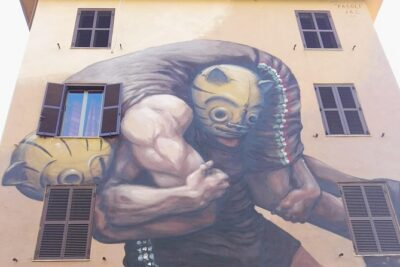
Naples Essentials: Monuments, Local Life & Street Art
Read our review →
4×4 tour of Orgosolo: Murals and typical lunch at the shepherd’s
Read our review →
Rione Sanità tour among baroque, revival, street art & food
Read our review →
The Spanish Quarters, Street Art and Local Market
Read our review →Browse the lists this tour appears in