
REVIEW · BOGOTA
Fun Graffiti Workshop: The Art of Aerosol and Color
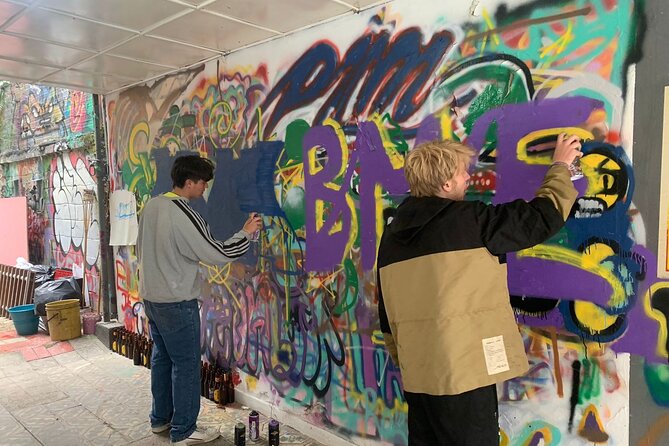
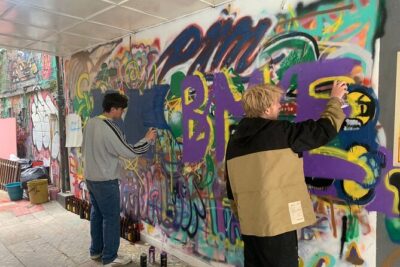
Bogotá’s graffiti culture is best understood with a spray can in your hand, not just through a walking tour. At Ocio Gallery, you invent a graffiti name, practice simple marks, and turn it into a 3D throw-up style piece on a courtyard wall. I like the clear progression from paper exercises to the final wall, and I like that the workshop also includes time in a gallery filled with Colombian prints. The main drawback is practical: some paint cans may be empty or nearly empty, which can limit your color choices.
The small group size, capped at 10 people, gives the instructor room to help with your letter shapes and color plan. Guides such as Cali, known professionally as TET, and Diego work well with families and first-timers. Still, the experience depends partly on the group around you. A noisy family group can make an adult art session feel less focused.
Key points to know before you book
- You create your own graffiti name: The workshop is not just a demonstration. You design a tag and paint it yourself in a beginner-friendly 3D style.
- The lesson starts with simple spray exercises: Dots, lines, and spirals help you learn how a can responds before you attempt letters.
- Ocio Gallery adds a cultural stop: You can see Colombian prints, murals, photographs, and printed clothing before working in the rear courtyard.
- Cali, or TET, gives hands-on instruction: He explains can control, helps plan the piece on paper, and coaches you at the wall.
- The two-hour format is compact: You get a real introduction without giving up most of your day in Bogotá.
- Paint supplies can vary: Color selection may be limited if cans are empty or close to empty.
Starting at Ocio Gallery on Carrera 5
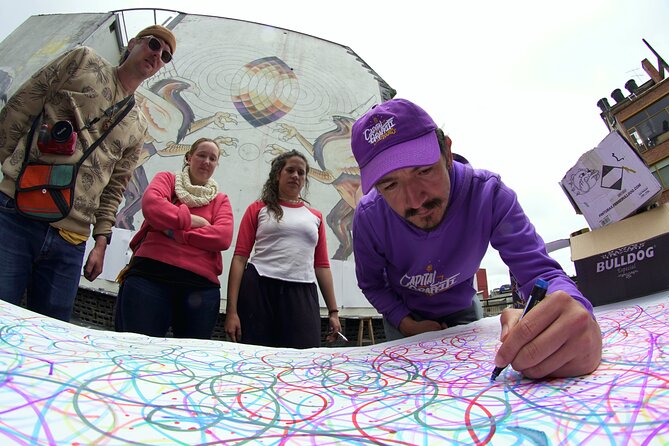
The workshop begins at Ocio Gallery, at Cra. 5 #26b-26 in Bogotá. The location is near public transportation, so you can reach it without arranging a private transfer. Transportation is not included, and the activity returns to the same meeting point when the class ends.
Ocio Gallery is more than a place to collect spray cans and paint a wall. You begin with a chance to look around the space, which displays prints by Colombian artists along with photographs and printed clothing. This opening visit gives the class a useful setting. You are not treating graffiti as a random craft project. You are seeing it alongside other forms of local art and design.
I would allow a few minutes to get oriented before the formal lesson begins. The gallery is also close to La Perseverancia Market and several places to eat, so you can pair the workshop with lunch or a snack before or after the class. Food is not included, but the location makes that easy to arrange on your own.
The workshop uses a courtyard behind the gallery. Its walls carry experiments and tags from past participants, so you can see the kind of work the class produces before you pick up a can. That setting feels more useful than a blank studio wall. You get an immediate sense that graffiti grows through repetition, practice, and shared public surfaces.
More Graffiti Tours in Colombia
- Medellin: Comuna 13 Graffiti Tour, Cable Car & Street Food
★ 4.8 · 9,046 reviews - Medellín: Comuna 13 Tour with Snacks And Your Own Graffiti
★ 4.9 · 311 reviews - Bogotá: La Candelaria Graffiti & Urban Art Guided Tour
★ 4.7 · 250 reviews
Warming up your hands before the first can
The instructor begins by explaining the purpose of the session: invent a graffiti name and paint it in a 3D throw-up style. Materials and quantities are shown, and you are asked for permission before photographs are taken. That consent step is worth noting, especially if you prefer not to appear in pictures.
Before the paint comes out, you are encouraged to stretch your body and hands. It may sound minor, but spray-painting uses your wrist, fingers, and shoulder in unfamiliar ways. A short warm-up helps you loosen up and signals that control matters more than brute force.
Then comes the memorable can-shaking demonstration. The instructor shakes the can and gives a creative presentation, mimicking a giant signature in the air. It is a playful way to show that graffiti is about movement and rhythm as much as lettering.
You work with spray cans, graphic markers, nozzles, thick paper, and wall space. Having these supplies provided keeps the session simple. You do not need to arrive with art materials or know what type of nozzle to buy.
Learning dots, lines, spirals, and can control
The first exercises are deliberately plain: dots, lines, and spirals. These marks teach you how close to hold the can, how quickly to move, and how much pressure and motion affect the paint. If you have never used spray paint, this stage prevents the first letter from becoming an accidental cloud.
Cali, also known as TET, has led participants through these basics and then helped them develop a tag. His role is not limited to showing you a finished piece. He offers ideas, points out ways to shape the letters, and helps you think about the final design before paint touches the wall.
That planning stage is one of the best parts of the class. You first work on paper, where it is easy to change the height, spacing, and outline of your letters. The instructor can help make the design more readable and more dramatic before you commit to a full-size wall.
Diego is also identified as a guide for the workshop, and he has worked especially well with children during the two-hour session. The exact guide may depend on the day, but the setup is built for beginners. You do not need to know graffiti terms or arrive with a prepared name.
Inventing a name and building a 3D throw-up
The central assignment is to invent a graffiti name. It can be a nickname, a shortened word, or a new combination of letters. The point is to build a personal tag rather than copy a design from a template.
The phrase 3D throw-up style refers to a bold, fast-looking form with inflated letters, strong outlines, and added depth. You are not expected to produce a polished mural in two hours. Instead, you learn how a simple word can become a graphic piece through shape, outline, shadow, and color.
The instructor helps you choose colors and refine the plan on paper. This matters because spray paint can look different on the wall than it does in your head. A short color plan also keeps you from wasting paint while you are still deciding what to do.
Once you move to the courtyard wall, the teacher coaches you as you work. That help can include shaping a letter, adjusting an outline, or adding a detail that makes the tag read more clearly. The goal is not for the instructor to take over. You get a finished piece that still comes from your own idea, with some expert correction when the form needs help.
Expect paint on the wall, not a take-home canvas. Thick paper is used for planning and practice, while the final work takes place in the shared courtyard. The wall gives the activity a genuine street-art feel, but it also means your piece remains part of the workshop space after you leave.
More Graffiti Workshops in Colombia:
- Fun Graffiti Workshop: The Art of Aerosol and Color
★ 5.0 · 3 reviews - NYC: Brooklyn Graffiti Workshop with Local Artist
★ 4.8 · 570 reviews - BYOB Spray Paint and Sip at Studio W.I.P.
★ 5.0 · 401 reviews - London: East End Street Art Tour and Spray Painting Workshop
★ 4.8 · 297 reviews
Why the gallery visit adds real value
Many art classes could take place in any city. This one gains something from beginning at Ocio Gallery. The prints, photos, clothing, and murals connect your own experiment to Bogotá’s wider art scene.
You might find the gallery visit especially useful if you are new to Colombian graphic art. It gives you visual ideas before you begin designing your tag. You can look at line work, lettering, and color choices, then test a small version of your own idea on paper.
The gallery also offers printed clothing, which may make a more distinctive souvenir than a standard Bogotá gift-shop item. You are not required to buy anything, but the option is there if you want to take home work by a Colombian artist.
The nearby La Perseverancia Market and food options make the meeting point convenient for a half-day plan. You could eat nearby before or after the class, though the workshop itself includes no meal. Keep that in mind when planning your timing, since the advertised duration is about two hours and the activity ends back at Ocio Gallery.
Group size, family fit, and the social side
The maximum group size is 10 people. That is small enough for a teacher to look at individual designs rather than simply spray a sample and send everyone off to work. For a hands-on art lesson, this limit is important because beginners often need help at several points.
Families can enjoy the class. Diego has been described as interactive with children, and the activity is open to most people. Young children may like the color and movement, but parents should expect the workshop to be an active art session rather than a quiet museum class.
The group mix can affect the mood. A calm adult group may get more focused coaching and time to refine each tag. A group with several very young children may be louder and less orderly, especially if parents do not stay involved. That is not a flaw in the graffiti lesson itself, but it is a fair consideration if you want a serious, concentrated art workshop.
Adults should not assume the class is only for families. The exercises, paper planning, color decisions, and wall work give adults plenty to do. You will get the most from it if you treat the session as a creative lesson rather than a quick photo opportunity.
The real value of the $58 price
At $58 per person, this is not the cheapest way to spend two hours in Bogotá. The price makes more sense when you count what is supplied: spray cans, nozzles, graphic markers, thick paper, instruction, wall space, and access to the gallery and cultural house.
You are paying for guided practice, not just materials. A can of paint is easy to buy, but learning how to control it, plan a tag, and make a piece readable is harder without help. The instructor’s corrections at the wall are the part most difficult to recreate on your own.
The value is strongest for people who want an activity they can remember and explain afterward. You do not simply look at Bogotá’s graffiti scene. You learn a small part of its working process and leave with photographs of the experience if you give permission for them to be taken.
The value is less convincing if you mainly want a polished souvenir or a long lesson in Bogotá’s street-art history. The session focuses on making your own piece. It does not promise transportation, food, or a full city tour, so those should not be part of your price comparison.
Practical details that can shape your day
The class lasts about two hours and ends where it starts. It is near public transportation, and most people can take part. Confirmation is sent within 48 hours of booking, subject to availability, and the group cannot exceed 10 people.
Book with a little advance notice. The experience is booked an average of 34 days ahead, which suggests that popular dates can fill before your trip. A confirmation is still subject to availability, so do not leave it until the final day if the workshop is important to your plans.
Paint supplies are one area where you should keep expectations realistic. One session had too many empty or nearly empty cans, which reduced the range of available colors. That can be frustrating when you have planned a design around a specific shade. The instructor can still help with the piece, but you may need to adapt your color plan.
You can cancel for a full refund if you do so at least 24 hours before the start time. Cancellations made later are not refunded, and changes made within that period are not accepted. If the minimum number of participants is not reached and the activity is canceled, you can receive a full refund or choose another date or experience.
Who will get the most from this graffiti class
I would choose this workshop if you want a creative break from museums, churches, and city walks. It works particularly well for first-time spray-paint users, couples, families with older children, and anyone curious about Bogotá’s graffiti culture but unsure how to approach it.
It also suits people who like a clear task. You learn basic marks, invent a name, plan on paper, select colors, and paint the wall. The class has enough structure to keep you moving, but enough freedom for each person’s tag to look different.
You may want to skip it if your priority is a quiet, highly polished art lesson with guaranteed access to every color. You should also think twice if you dislike shared group activities or do not want children in the same courtyard. The small group cap helps, but it cannot control the personality or energy of everyone booked that day.
Should you book the Ocio Gallery workshop?
I would book it if you want to do more than photograph Bogotá’s murals. The best features are the step-by-step teaching, the gallery setting, and the chance to turn a simple invented name into a real wall piece. Cali, or TET, and Diego bring different strengths, but both are associated with a beginner-friendly session that welcomes families and first-timers.
Go in ready to adapt. Your favorite color may not be available, and the group may be noisier than expected. Even with those limits, $58 is reasonable for a supplied, guided art activity in a central Bogotá gallery, especially if you value a personal experience over a standard souvenir.
FAQ
Where does the graffiti workshop start?
It starts at Ocio Gallery, Cra. 5 #26b-26 in Bogotá, Colombia.
Where does the activity end?
The workshop ends back at the meeting point, Ocio Gallery.
How long does the workshop last?
The activity lasts approximately two hours.
What will I make during the class?
You will invent a graffiti name and paint it in a 3D throw-up style.
Are spray-paint materials included?
Yes. Spray cans, graphic markers, nozzles, thick paper, and wall space are included.
Is transportation included?
No. Transportation is not included, although the meeting point is near public transportation.
How large is the group?
The activity has a maximum of 10 participants.
Can I cancel for a full refund?
Yes, if you cancel at least 24 hours before the experience start time. Cancellations made less than 24 hours in advance are not refunded.
Just added around Colombia
- Comuna 13 Neighborhood & Street Art Private Tour★ 4.7 · 12 reviews
- Medellin: Graffiti Tour Comuna 13★ 4.1 · 14 reviews
- Medellín Comuna 13 local guides snacks and your own graffiti★ 4.9 · 13 reviews
- Comuna 13: Recorrido de Arte Urbano, Cultura y Resiliencia★ 5.0 · 3 reviews
- Graffiti Tour: a fascinating walk through a street art City★ 5.0 · 5 reviews
- Fun Graffiti Workshop: The Art of Aerosol and Color★ 5.0 · 3 reviews
- Comuna 13: Graffiti Tour with Tasting, Live Show, & Gallery★ 5.0 · 4 reviews
- Comuna 13: Graffiti tour & Street Food/drink with telesferic★ 4.4 · 19 reviews
Bogota Street Art Tours, compared.
Bogotá: La Candelaria Graffiti & Urban Art Guided Tour
Read our review →
Graffiti Tour in La Candelaria Bogotá with Transportation
Read our review →
Bogotá: Graffiti Tour el mejor recorrido de arte urbano
Read our review →Graffiti Tour in La Candelaria Bogotá with Transportation
Read our review →
Graffiti Tour: a fascinating walk through a street art City
Read our review →
Browse the lists this tour appears in